https://www.youtube.com/watch?v=eXNTyftGnp0
Geolier – El pibe de oro
 ù
ù

https://www.youtube.com/watch?v=eXNTyftGnp0
Geolier – El pibe de oro
ù
Hey you – Pink Floyd https://www.youtube.com/watch?v=DEDjF2tLbhk

stanotte ho lavorato all’assemblaggio di questo documento, ringrazio chi mi ha coinvolto in quest’avventura e tutti gli autori, gli artisti, gli organizzatori, i fotografi e gli attori che hanno portato alla luce un argomento così scottante, spero che condividerlo sia utile
occorrerebbe politicamente imitare il New Hampshire (faccio riferimento all’articolo sul New Hampshire tratto da L’Internazionale pubblicato su questo sito e datato 2016 in poi dal punto di vista argomentativo) – articolo n. 6 (non tutti gli articoli di cui a questo sito sono numerati giacché è possibile leggerli in ordine sparso).
Mi sono permessa di commentare relativamente alle poltrone d’oro solo perché il giorno dopo aver pubblicato quest’articolo, non scritto da me ma da me assemblato aggiungendo come mio solito i brani musicali, la città è stata tappezzata da manifesti elettorali – ora, se da un lato è vero che per certi versi la politica è ritenuta necessaria per la cooperazione incluso l’aiuto ai nostri fratelli neri, dall’altro usare l’Africa e il suo popolo è un gesto di mancanza di rispetto assoluto, è un modo gentile di calpestarne i diritti facendo affari da miliardi
https://www.youtube.com/watch?v=MR8Q7ARB14M – Get up, stand up Bob Marley

https://ytali.com/2025/10/06/marco-cavallo-the-blue-horse-that-never-stopped-running-where-the-journey-meets-the-border/
While the globally resonant and historic journey of the “Global Sumud Flotilla” has literally kept half the world holding its breath for over six weeks, and continues to do so with the vessel “The Conscience” dedicated to Gaza’s besieged and targeted healthcare system, now just a few miles from Palestinian territorial waters, another symbolic journey has, for exactly a month, been unfolding across Italy. Crossing the boundaries of land, mind, and detention, it has, in its own smaller yet no less significant sphere, stirred the country with vivid intensity, between mental health and incarceration. This latter journey has sparked conversations from the eastern border city of Trieste to the southern port of Bari, facing Albania, reviving both past and present debates on mental health, dignity, and detention, all rooted in the legacy of Franco Basaglia. At its heart stands Marco Cavallo, a four-metre-tall blue horse originally crafted from papier-mâché and wood, now reproduced in fiberglass to withstand long travels. Part sculpture, part symbol, and part traveling protest, Marco Cavallo once broke through the walls of a mental institution. Now, fifty years later, he is knocking on the gates of Italy’s detention centres for migrants.
Who is Marco Cavallo? Man or horse?
“Una mattina era arrivato in visita, sul prato della direzione, un destriero blu di cartapesta, montato su ruote, lunghe zampe, alto quattro metri. “Marco” lo chiamavano; era il cavallo che un tempo trascinava il carretto con la biancheria da lavare, per tutti il simbolo della libertà conquistata.”
(“One morning, on the lawn of the hospital administration, a blue papier-mâché horse appeared. Mounted on wheels, long-legged, four meters tall. They called him “Marco”; the horse who once pulled the laundry cart, for everyone there, he became the symbol of freedom regained.”)
Marco Cavallo was born in 1973 inside the psychiatric hospital of Trieste, not necessarily as a living creature but specially as an act of collective imagination created by artists and patients built him together, among whom were Vittorio Basaglia, Giuliano Scabia, Federico Velludo, Ortensia Mele, Stefano Stradiotto, under the guidance of psychiatrist Franco Basaglia, the man who would revolutionise mental health care in Italy and beyond.
The name comes from a real horse once employed inside the asylum (manicomio in Italian) to carry laundry and kitchen supplies. Coincidentally, or perhaps symbolically, the Italian language is full of expressions linking horses and madness, among them the saying “Matto come un cavallo” (“Crazy as a horse”). Yet here, madness lies neither in the horse nor in those once confined within those walls, it lies rather in the fact that society waited so long to confront it. That very madness has since been overcome and reimagined, collectively transformed into a shared act of meaning-making that continues to resonate, fifty years later, from the North to the South of the Italian peninsula.
When the animal grew old and was about to be put down, patients and nurses protested, writing to the provincial authorities to save him. The horse was granted retirement inside the asylum, a small yet profound victory in a place built to suppress humanity and empathy.
That act of defiance actually inspired something greater. Within the hospital’s creative workshop, patients and artists came together to rebuild Marco Cavallo as an immense blue sculpture that would have been large enough, they hoped, to “contain all our dreams and desires.”
In March 1973, when the horse was wheeled through the asylum gates and out into the streets of Trieste, more than 500 people joined the procession. It was hailed as “the beginning of the end” of confinement in Italy’s manicomi a moment that burst open like a symbol of liberation, a day of joy and rebellion, a collective cry for freedom and dignity under the open sky.
The blue horse’s first journey indeed marked the beginning of a historic transformation: the abolition of manicomi in Italy through the “Basaglia Law” or “Law 180”, passed in 1978. The law is more than mental health legislation, as it can be considered a manifesto of humanity, a collective commitment to freedom and responsibility. Since then, Marco Cavallo became an icon of the struggle against psychiatric institutions and a symbol of liberation that travelled the world, from festivals to hospitals, from protests to exhibitions. In 2015, he was displayed at EXPO Milano under the slogan “Nitrire al pianeta” (“Neighing for the Planet”), reminding the public that human rights and mental health are inseparable in the realms of struggle, advocacy, and awareness, as well as within the broader vision of global healthcare.
The enduring message of Franco Basaglia
Behind Marco Cavallo stood the towering figure of Franco Basaglia, the prominent psychiatrist who was born and died in Venice (1924–1980), and who turned the philosophy and approach to mental health on its head. His revolution was not just medical: it was moral, philosophical, cultural, architectural and profoundly political one whose legacy remains strong today despite his institutional marginalisation.
Basaglia believed that madness was not merely an illness of the individual but a symptom of society itself, a conviction that resonates with the saying “Chi non ha, non è” (“Those who have nothing, are nothing”), which he often quoted from popular speech in Southern Italy to denounce a culture that measured human worth by possession. For him, illness and crime could not be separated from social inequality, isolation, and the dehumanising pressures of modern life, nor could any fragmented approach to healing and care ever be effective or realistic.
As José María Álvarez Martínez writes in his chapter “Madness According to Basaglia,” included in the recent volume “Franco Basaglia’s Revolution. From the Blue Horse to the Actuality of His Practice” (Springer, 2025):
Basaglia stood out for his passionate activism and the practicality with which he implemented his ideas, dedicating his entire life to them as a psychiatrist, asylum director and mental health manager. Considering madness as the opposite of reason is a general approach that unites more than it separates. It is an approach that runs through our entire history since antiquity and will remain relevant in the future. And opposing this ethical and clinical stance is the other major approach that reduces madness to one or more illnesses and turns the mad person into a sick person, a sick person whom we, the specialists, must, according to the dictates of science, guard, care for and try to cure.
In Basaglia’s view, danger and divergence from social norms were part of the human condition and should be addressed through dialogue, not confinement. He already observed, sixty years ago, that those who disturbed the social order, whether through mental illness, poverty, or migration, were far too often locked away: first systematically in asylums (manicomi), in parallel in prisons, and today, in an institutionalised form, in CPR detention centres (Centri di Permanenza per il Rimpatrio), where migrants without valid documents are held. CPRs are, in effect, modern-day deportation and concentration camps for the invisible, without rights, guilty only of existing. A society that accepts these camps is accepting to be imprisoned, sooner or later, itself. It is in this sense, according to the philosophy of Marco Cavallo’s journey, that the CPRs speak to our own mental health.
Living in a sick society, according to Basaglia’s vision, marked by inequality, homelessness, marginalisation, unemployment, and racialisation, has a profound impact on mental health. This insight, echoed decades later by psychologists and members of numerous civil society organisations supporting the initiative “Il viaggio di Marco Cavallo nei CPR” (“The Journey of Marco Cavallo to the CPRs”) – among them Forum Salute Mentale, SIMM – Società Italiana di Medicina delle Migrazioni, Brigata Basaglia, and Associazione 180amici Puglia – resonates powerfully today, considering that the CPRs represent the highest expression of that unjust, psychiatric-oriented, and violent detention culture typical of the pre-Basaglia era, a system and a culture that never truly disappeared and is now even being exported elsewhere, as in the case of northern Albania.
Embarking on the journey across Italy visiting these detention centres, carrying with him the legacy of Basaglia’s radical thought, Marco Cavallo confronts the reality of administrative detention and its human consequences. Through public appearances, workshops, and community engagement, the journey transforms a symbol from psychiatric liberation into a broader statement about freedom, dignity, and the rights of those society seeks to render invisible. In doing so, it challenges the very structures of control that Basaglia critiqued decades ago, turning art and activism into a living, mobile act of resistance.
Basaglia: radical change without honour
Basaglia’s legacy transformed the world and the medical discipline, though not always his own country. Born in Venice in 1924, he directed the psychiatric hospitals of Gorizia and Trieste, where he pioneered the idea of community-based mental health services as an alternative to detaining patients in manicomi. Yet in death, as in life, official recognition came slowly, especially in his birthplace, Venice.
The years in Gorizia were, above all, a period of intense commitment, particularly relevant for promoting and disseminating his ideas to a wider audience. Despite sharp conflicts with much of official psychiatry, the so-called ‘Gorizia group’ succeeded in gaining broad support, both within and beyond the specialist field, and became a reference point for opposition psychiatry, which was gradually gaining ground in both hospitals and universities. Considering the other main places of his life, it is telling that when he died on 29 August 1980, at only 56 years old, the local press in Venice and Trieste merely reported the news in the regional section, treating it with detachment and superficial neutrality. To this day, neither of the cities where he lived and worked has a street or square named after him, whereas Rio de Janeiro, where his ideas inspired major reforms and where he frequently delivered speeches, proudly does.
‘Nemo propheta in patria’, from the Latin expression meaning “no man is a prophet in his own land”, which reflects the universal struggle of radical innovators to be accepted, welcomed and understood in their home environment, once again holds true in Venice for such an intellectually and scientifically brilliant mind. During his life, Basaglia faced rejection from academia as well, being expelled three times from university posts for refusing to conform. “I have entered the university three times,” he recounted many times, “and three times I have been thrown out.”
Yet his radical ideas lived on, inspiring new generations and awareness-raising campaigns, such as the current initiative advocating for the closure of detention centres, challenging the boundaries between medicine and society, sanity and madness, and freedom and control.
Marco Cavallo’s new journey: from asylums to detention centres
Today, half a century later, Marco Cavallo is once again on the road. Thanks to the collective efforts of Forum Salute Mentale, Mai più lager – No ai CPR, and dozens of other networks, associations, activists, and citizens, the blue horse has returned to travel through Italy this time to demand the closure of the CPR detention centres and the abolition of administrative detention.
After denouncing the inhumanity of Italy’s judicial psychiatric hospitals (OPG) and contributing to their closure, Marco Cavallo now visits a new generation of ‘invisible institutions’ where structural institutional racism is perpetrated, and violence is comprehensively present and dictating the rules. These CPR centres, officially created for the temporary retention of undocumented migrants, have become places of systematic violence, degradation, and psychological collapse, alongside the already similar versions present in many other countries on the European continent and beyond. These have even been exported by the Italian government to countries where they did not exist, and were not needed, in even more dangerous experimental settings of extraterritoriality regimes, such as the Lezhë district in northern Albania.
Unlike prisons, CPRs hold no convicts, nor do they possess clear or communicated judgments regarding those held there. Their inmates’ only ‘crime’ is lacking valid documents, a status often determined by bureaucratic opacity, political arbitrariness, or expired papers. They are prisons of inequality, where exclusion becomes institutional and human beings are reduced to case numbers. Here, once again, the concept of ‘possession’ already highlighted by Basaglia is pertinent, in this case reduced to a mere piece of paper that can close the doors of the world often with indefinite procedures and timelines.
The construction of the Gjadër detention centre in Albania, where the Italian government has established both the facilities and the legal mechanisms to transfer migrants previously held in CPRs, marks the rise of a transnational form of administrative detention. Under Decree-Law 37/2025, the Italian government began sending migrants overseas throughout 2025 – sometimes for the mere “offence” of possessing an expired document – under heavy police escort, with two officers per person, in an operation more symbolic than secure. In this context, the spectacle of control has replaced the promise of justice and crushed the “European dream” for migrants, as expressed by a popular slogan used by Albanian activists during the first deportation of migrants to the port of Shëngjin last October, displayed on banners reading: “The European dream ends here.”
This policy, enacted by the Italian government, reflects a broader European trend that risks further replicating the externalisation of borders, the outsourcing of detention, and the normalisation of confinement as routine administrative practice. The same logic that once justified asylums, protecting society from its own fears, is returning, cloaked in bureaucratic language and geopolitical convenience.
A journey of denunciation and hope
Between 6 September and 10 October 2025, Marco Cavallo is retracing a symbolic map of Italy’s sites of confinement. His journey began in Gradisca d’Isonzo, in north-eastern Italy, and continued through Milan, Rome/Ponte Galeria, Palazzo San Gervasio, and then heading off to Brindisi/Restinco and Bari, culminating on 10 October, to coincide with World Mental Health Day.
Each stop of the horse’s journey is marked by public events, discussions, open assemblies, and artistic performances. Among these is the theatrical play “Reietti. Come creammo i CPR” (“Outcasts: How We Created the CPRs”), written and produced by Oscar Agostoni in collaboration with Disturbi Teatro, which, after performances in Milan and Turin, will be staged at the Santa Chiara cultural space in the centre of Brindisi, Apulia. Through storytelling and meticulous research, this powerful monologue exposes the conditions within Italy’s CPRs, recounting nearly 50 deaths that have occurred in these centres since 1998, and issuing a call to abolish the CPR system in favour of a more humane approach to migration.
Also in Brindisi, the photographic exhibition “The Adriatic Guantánamo ~ La Guantánamo Adriatica” by Nicolas Lesenfants Ramos will be on display, featuring striking images of the detention centres in Gjadër and Shëngjin, Albania, first exhibited and curated by the “House of Compassion” in Brussels. This exhibition serves as a bridge between the Italian mobilisation and the broader “Network Against Migrant Detention”, highlighting the alarming proximity between the CPR of Restinco, on the outskirts of Brindisi, and the Albanian facility of Gjadër, which is located just under 200 kilometres away across the Adriatic Sea. Indeed, Restinco is the closest Italian CPR to Gjadër, and many migrants deported from Brindisi have been sent there via the Italian Navy, highlighting the transnational dimension of Italy’s detention system.
In Rome, on 27 September, the great blue horse met a herd of papier-mâché horses created over the past three years by the Monte Mario Artists’ Collective. Old and new creations stood side by side, proving, as one participant said, that «history never stops galloping». The echo of asylum walls collapsing in the 1970s now resounds against the walls of the CPRs: camps of deportation and concentration for the invisible people on the move, without rights, guilty only of existing.
The filmmaker Giovanni Cioni and his crew are documenting the entire journey in a film that will preserve the voices and faces encountered along the way. As he describes it: “It will be an epic journey, and coincidentally, the route concluding in Brindisi and Bari retraces the flight to Brindisi of Spartacus’ army of slaves. An epic journey across the geography of invisible places, lost in the peripheries or in abandoned locations.” Along the route, volunteers are delivering letters of solidarity to detainees, under the form messages of presence and hope written by people from across Italy and abroad.
Each stage of the journey is stitched together by flags sewn from discarded fabrics: a poetic and political gesture in which every seam represents a meeting between different lives, textures, and worlds and it is a metaphor for dignity and creativity that endures even in the harshest conditions.
A shared campaign for humanity and dignity
The journey of Marco Cavallo is part of the awareness-raising campaign “180 Bene Comune” (“Law 180: A Common Good”), launched by the Forum Salute Mentale (Mental Health Forum). Defending the legacy of the Basaglia Law today means defending the idea that dignity knows no borders, that no one should be hidden away or detained for being considered divergent, vulnerable, sensitive, ill, or simply coming from elsewhere, seeking refuge, or hoping to build a better future and reshape their prescribed destiny. Yet this principle is under threat, not only in Italy, but across Europe and much beyond.
“Finché c’è un lager, non ci può essere cura” (“As long as there is a concentration camp, there can be no care”), a statement attributed to Basaglia and echoed today by doctors and activists, captures the moral essence of Marco Cavallo’s new odyssey. Building on this, the horse’s journey is not merely an act of protest but also a therapeutic exercise in collective memory, reminding Italian society as a whole of the ethical foundations of the mental health reform and of Basaglia’s leading role at the European level.
As Basaglia taught that illness cannot be healed through exclusion, so too do today’s initiators and participants in the blue horse’s journey reminded everyone that human mobility cannot be governed through detention and social control.
Culture as resistance and a lifelong journey
Every stop along Marco Cavallo’s route becomes a festival of resistance. Musicians, actors, and citizens come together to transform protest into art. In small towns like Cori and Cisterna di Latina, both in Lazio on the way to the south of the country and far from major urban centres, local activists organise performances and public debates, proof that this movement thrives not only in Italy’s big cities, but also in its less visible, yet equally vibrant and socially committed, peripheries.
It is no coincidence that the stop in Basilicata, outside the CPR of Palazzo San Gervasio, also far from urban centres, scheduled on 3 October, coincided with Italy’s National “Day of Remembrance and Reception” (Giornata della Memoria e dell’Accoglienza), established to commemorate the Lampedusa shipwreck of 3 October 2013, in which 368 migrants lost their lives. The date was chosen as a symbol not only to remember the victims of Lampedusa, but also to honour all those who have perished – and who continue to die daily – in the Mediterranean Sea and along Europe’s borders.
Sometimes, the blue horse appears unexpectedly along its journey at cultural events such as the “InSania Festival – Counter-Narratives of Madness”, held during the summer months in Cori and Cisterna di Latina, in southern Lazio, a special Festival on mental health, where art and psychiatry intersect, that followed the stop in Rome at the end of August. Also there, as wherever he goes, Marco Cavallo carried with him a strong and unwavering message: “imagination can dismantle walls, both physical and mental ones”.
Join the Journey: Until the End and Beyond
According to its initiators, supporting this project means defending not only Law 180, but also the very principle that inspired it: that freedom is therapeutic. Each stage of the journey features public dialogues, testimonies, and collective reflections on rights, dignity, and justice through a physical symbol of liberty that continues to inspire stories, break silences, unite people and weave a new narrative of hope.
Thus, fifty years after he first burst through the gates of Trieste’s asylum, Marco Cavallo is still galloping through cities and countrysides, through history and conscience. His body may appear fragile, but his message endures: every society must measure its humanity by how it treats those it locks away.
In the eyes of those who walk beside him today – psychiatrists, migrants, artists, and citizens – the blue horse is not a relic, but a companion. He reminds each traveller that freedom must be defended again and again, that the journey toward dignity never ends, and that even the most fragile voices can, together, make the loudest sound.
“The resignification of meaning – explained Giuliano Scabia, one of Marco Cavallo’s creators, who passed away in 2021 – was built by the mad”. He continued, saying that: “We rebuilt Marco the horse by recovering the sense of the symbol of freedom it once held for the asylum’s patients, who, thanks to the Basaglia Law, became free people once again.”
In its tireless quest for freedom and meaning, Marco Cavallo still rides today, a blue silhouette of defiance, carrying within it all the gestures of “madness” that have dared to resist injustice and embody its message. From Trieste to Brindisi, from the asylums of yesterday to the detention camps of today, the horse traces a map of Italy’s wounds and hopes, reminding Europe that the fragile line between care and control, between reason and madness, is constantly being redrawn.
Now, as it turns its gaze across the Adriatic toward Albania, the horse seems once again to whisper the lesson of its own birth: that freedom is not a destination to reach, but a way of moving through the world a living practice, renewed with each encounter, each act of courage, each fragile alliance. So, it continues, gathering new companions and new meanings, as the long journey toward dignity unfolds, fragile yet unbroken.
https://www.youtube.com/watch?v=XpDA51zyLOM – Ras Tewelde One way ticket (biglietto di sola andata)
https://www.africarivista.it/perche-non-tutti-i-migranti-africani-scelgono-leuropa/217406/
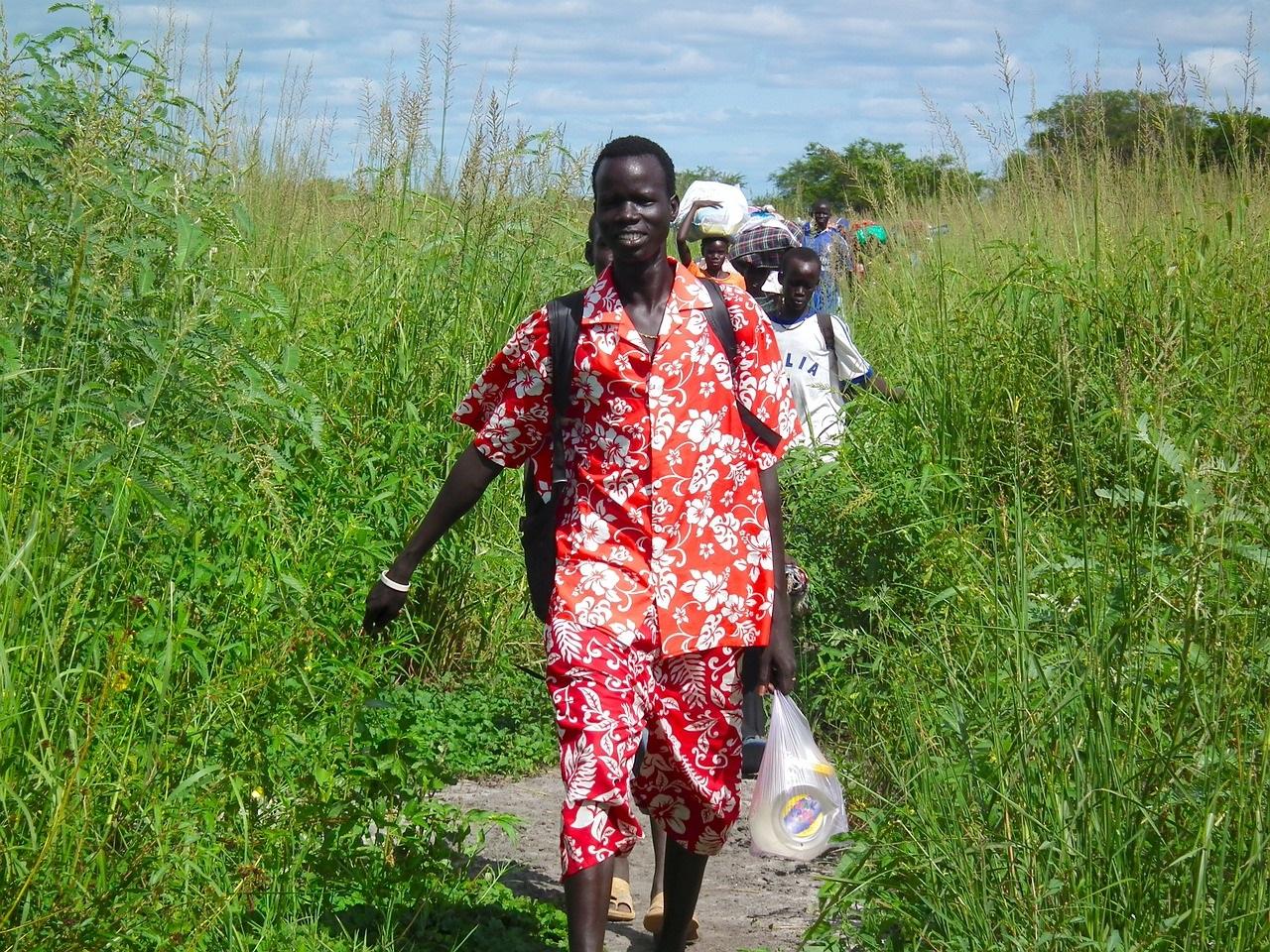
immagine Web v. articolo
Gli africani non procedono in massa verso l’Europa: l’approdo di gran parte dei migranti subsahariani resta infatti interno al continente e gli spostamenti avvengono spesso in un Paese della stessa regione. Quali sono i flussi, le nazioni che attirano, e le ripercussioni?
L’Africa ospita attualmente il più alto numero di persone costrette a fuggire: quasi 36 milioni sulle oltre 84 milioni sono costrette alla fuga da conflitti, violenze, persecuzioni e cambiamenti climatici. Tuttavia, nonostante questo dato drammatico, gli africani non procedono in massa verso l’Europa. I dati a conferma di questa, forse un po’ scomoda affermazione, specie per alcuni membri della classe politica del Vecchio Continente, anche italiana, che sulla narrazione della “invasione” da parte dei migranti provenienti dal Continente africano hanno raccolto i loro consensi, giungono tanto dai tassi di emigrazione della regione, ovvero la percentuale di africani che lascia il proprio paese sul totale della popolazione di appartenenza, che risultano essere sostanzialmente in linea con quelli globali, quanto dal fatto che l’approdo di gran parte dei migranti, ad esempio di quelli subsahariani, resta interno al Continente.
Soltanto un terzo dei 27 milioni di emigrati che, ad esempio, al 2017 originavano dall’Africa subsahariana, una volta lasciata la propria terra si è poi stabilita in Europa, Nord America, Medio Oriente: la “fetta” più grossa dei migranti subsahariani ha infatti sì attraversato i propri confini ma soltanto per spostarsi in uno stato limitrofo, o addirittura per “fermarsi” in Africa.
Rispetto ai processi migratori del Nord Africa, quelli dell’Africa subsahariana sono dunque principalmente e anzitutto fenomeni intra-regionali.
Oltre la ricerca di migliori condizioni economiche
In Africa subsahariana, come in altre parti del mondo, vi sono marcate differenze tra i singoli Paesi in termini di opportunità economiche, di rischi politici e climatico-ambientali, nonché in termini di tendenze demografiche. Specifici percorsi migratori vengono poi replicati e stabilizzati dall’esistenza di reti di contatti che spesso facilitano e favoriscono il privilegiare, da parte dei migranti, di alcune destinazioni rispetto ad altre: si pensi, ad esempio, alla presenza di una diaspora nigeriana molto numerosa in Sudan, paese non confinante ma che comunque possiede affinità culturali rispetto ad alcune comunità nord-nigeriane.
D’altra parte, tra le preferenza dei migranti, vi è quella di approdare in quei Paesi con le economie più forti e diversificate: i corridoi migratori sono così diretti verso economie che offrono opportunità di lavoro, nei settori agricolo o minerario per chi muove dal Burkina Faso e dal Mali verso la Costa d’Avorio, ad esempio, così come dallo Zimbabwe e dal Mozambico verso il Sudafrica.
Le ripercussioni nei territori di approdo dei flussi
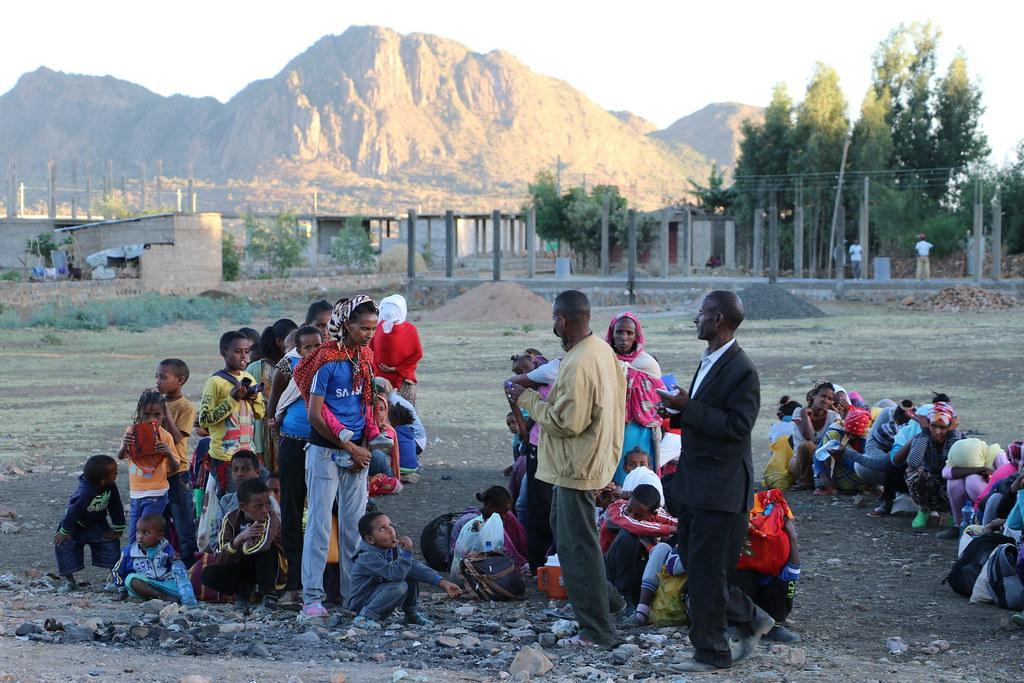
D’altra parte, le pressioni demografiche conducono alcune aree ai limiti della sostenibilità, intensificando i processi di urbanizzazioni, lo sfruttamento, la competizione e la frammentazione delle terre. A ciò si aggiungono le sfide connesse al cambiamento climatico, inclusa la desertificazione e il moltiplicarsi di fenomeni climatici estremi. La Banca mondiale prevede infatti che ci saranno 86 milioni di migranti per il cambiamento climatico in Africa entro il 2050. Il Global Warming, vale a dire il costante aumento della temperatura globale che sta avendo un impatto sui cambiamenti climatici, sta rendendo inabitabili alcune regioni dell’Africa, accelerando il modello di migrazione dalle zone rurali a quelle urbane, verso le metropoli africane.
Tra il 2020 e il 2030, le sette città costiere più popolose dell’Africa, come Lagos, Luanda, Dar es Salaam, Alessandria, Abidjan, Città del Capo e Casablanca, dovrebbero crescere del 40 per cento. In questi contesti, la duplice pressione demografica e l’innalzamento dei livelli del mare sulle infrastrutture urbane e agricole, unitamente all’accesso all’acqua nelle città costiere potrebbe incrementare la vulnerabilità della governance e della sicurezza interna.
Una possibile Road Map
La maggior parte delle migrazioni africane sembra dunque essere indirizzata verso i centri economici del continente: un modello che si prevede continuerà man mano che le economie regionali diventeranno più integrate. Considerando inoltre i continui forti fattori di spinta si può prevedere che questa tendenza proseguirà costantemente anche in regione del fatto che secondo l’Africa Migration Report, l’80 per cento dei migranti africani non ha interesse a lasciare la propria terra.
I flussi intra-africani, ancora relativamente poco studiati e analizzati in Occidente, meriterebbero maggiore interesse a livello politico nonché una più ampia copertura mediatica. Sarebbe auspicabile un confronto costruttivo e duraturo che coinvolga tutte le realtà in grado di fornire un contributo concreto in Europa e in Africa sulla falsariga di quanto avvenuto nel 2006 quando l’Unione Africana adottò a Banjul, in Gambia, il Quadro politico migratorio per l’Africa (MPFA), ovvero un insieme di linee guida non vincolanti destinate a supportare i governi africani e le Comunità economiche regionali nella formulazione dei propri programmi nazionali con riferimento alle politiche migratorie per l’Africa. Nazioni Unite e l’Unione europea potrebbero poi attivarsi per favorire una governance globale delle migrazioni a patto naturalmente di ricevere le dovute deleghe di competenze da parte degli Stati nazionali che dovrebbero mettere in atto politiche pubbliche coraggiose ed efficaci, basate su corridori umanitari, flussi regolamentati e accordi tra paesi di partenza e di approdo.

https://www.youtube.com/watch?v=QP1EGudMF3M&list=RDQP1EGudMF3M&start_radio=1
Dignity – Deacon Blue
THERE’S A MAN I MEET
WALKS UP OUR STREET
HE’S A WORKER FOR THE COUNCIL
HAS BEEN TWENTY YEARS AND HE TAKES NO LIP OFF NOBODY AND LITTER OFF THE GUTTER PUTS IT IN A BAG AND NEVER THINKS TO MUTTER AND HE PACKS HIS LUNCH IN A SUNBLEST BAG
THE CHILDREN CALL HIM BOGIE
HE NEVER LETS ON BUT I KNOW ‘CAUSE HE ONCE TOLD ME HE LET ME KNOW A SECRET ABOUT THE MONEY IN HIS KITTY
HE’S GONNA BUY A DINGHY GONNA CALL HER DIGNITY
AND I’LL SAIL HER UP THE WEST COAST THROUGH VILLAGES AND TOWNS I’LL BE ON MY HOLIDAYS THEY’LL BE DOIN’ THE ROUNDS
THEY’LL ASK ME HOW I GOT HER
I’LL SAY I SAVED MY MONEY THEY’LL SAY ISN’T SHE PRETTY THAT SHIP CALLED DIGNITY
AND I’M TELLIN’ THIS STORY IN A FAR AWAY SCENE SIPPIN’ DOWN RAKI AND READIN’ MAYNARD KEYNES
AND I’M THINKIN’ ABOUT HOME AND ALL THAT THAT MEANS
AND A PLACE IN THE WINTER FOR DIGNITY
AND I’LL SAIL HER UP THE WEST COAST THROUGH VILLAGES AND TOWNS
I’LL BE ON MY HOLIDAYS THEY’LL BE DOIN’ THE ROUNDS
THEY’LL ASK ME HOW I GOT HER
I’LL SAY I SAVED MY MONEY THEY’LL SAY ISN’T SHE PRETTY THAT SHIP CALLED DIGNITY
SAIL IT UP, SAIL IT UP SAIL IT UP, SAIL IT UP SAIL IT UP, SAIL IT UP YEAH, SAIL IT UP AGAIN SAIL IT UP AGAIN SAIL IT UP AGAIN SAIL IT UP AGAIN SAIL IT UP, SAIL IT UP SAIL IT UP, SAIL IT UP SAIL IT UP, SAIL IT UP YEAH, SAIL IT UP AGAIN SAIL IT UP AGAIN SAIL IT UP AGAIN SAIL IT UP AGAIN
AND I’M THINKIN’ ABOUT HOME
AND I’M THINKIN’ ABOUT FAITH
AND I’M THINKIN’ ABOUT WORK
AND I’M THINKIN’ HOW GOOD IT WOULD BE TO BE HERE SOME DAY ON A SHIP CALLED DIGNITY A SHIP CALLED DIGNITY THAT SHIP

data di pubblicazione su questo sito: 12/10/2025 e riemissione il 12/06/2026 al solo fine di sicurezza
https://www.youtube.com/watch?v=_dKlLHE6sMQ
Last night a dj saved my life with a song

Indeep – Last Night A D.J. Saved My Life (1983) Single Mix Formel Eins (Edit by CorbiOnn)
16/05/2026
https://www.youtube.com/watch?v=1UUYjd2rjsE
Send me an angel

art. 01/01/2026
https://www.youtube.com/watch?v=oWRr03VcA-0
The Rolling Stones – Angie

01/11/2023
https://www.youtube.com/watch?v=QZxLebrriPs
Bella – Jovanotti

Bella · Jovanotti Lorenzo 1997 – L’Albero ℗ 1997 Universal Music Italia Srl Released on: 1997-02-17 Vocalist: Jovanotti Composer Lyricist: Lorenzo Cherubini Composer Lyricist: Michele Centonze
12/06/2017
Grazie Lore!!